
A few weeks ago, I was commissioned to make a plate of Justice Harry Blackmun. The guy who ordered the plate was giving it to a friend of his who had clerked for Blackmun. When he ordered the plate, he asked that I not make any reference to abortion (not that I would have), as Blackmun authored the majority in
Roe v. Wade.
Roe notwithstanding, Blackmun drew the ire of conservatives as a justice who wound up a being a great deal more liberal than the president (Richard Nixon) who nominated him. Stevens (nominated by Ford) and Souter (nominated by Bush I) are the other big examples that played a outsized role in the rise of the conservative Federalist Society.
In a dissent of a denial of a petition to be heard by the Supreme Court, Blackmun beautifully voiced his opposition to the death penalty:
"From this day forward, I no longer shall tinker with the machinery of death. For more than 20 years I have endeavored--indeed, I have struggled--along with a majority of this Court, to develop procedural and substantive rules that would lend more than the mere appearance of fairness to the death penalty endeavor. Rather than continue to coddle the Court's delusion that the desired level of fairness has been achieved and the need for regulation eviscerated, I feel morally and intellectually obligated simply to concede that the death penalty experiment has failed. It is virtually self evident to me now that no combination of procedural rules or substantive regulations ever can save the death penalty from its inherent constitutional deficiencies. The basic question--does the system accurately and consistently determine which defendants "deserve" to die?--cannot be answered in the affirmative."
The whole opinion can be found
here.
Linda Greenhouse, who covers the Supreme Court for the New York
Times, recently wrote a
book about him that is supposed to be quite good. I have it by my bedside, but have yet to crack it.
I really enjoyed doing this drawing, and feel that it came out as well as any I have done. I always find the robes particularly difficult-- it is something about the gradations of black that magic markers don't really accommodate. His right arm got away from me but, I do feel good about the highlights above the book.
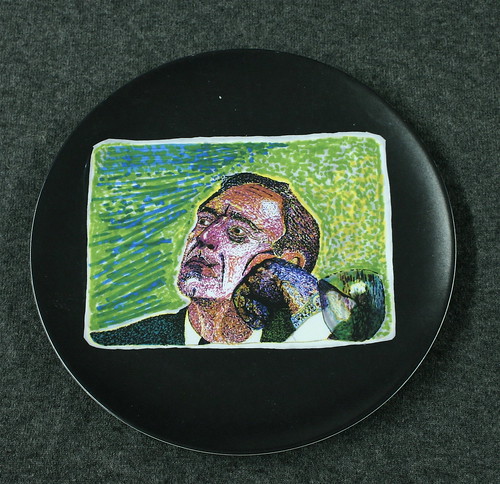 This is the plate I did of Samuel Alito, and is one of the first I made ever. I started with the face and was pleased to capture a hint of the paradoxical combination of boredom and vigilance that often marks his expression. (Though I am not sure the drawing really looks like him...). Then I got to that hand and really struggled to find the creases.


 Posts
Posts

